
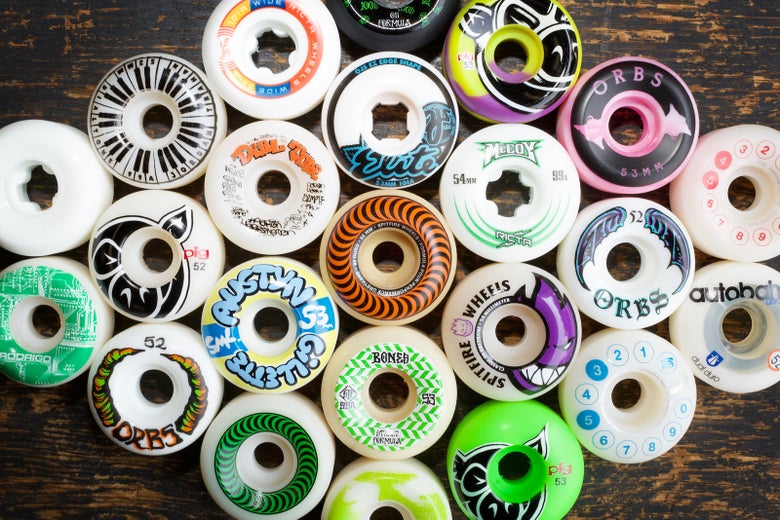
Skateboard Wheels
Put very simply, skateboard wheels are part of the skateboard that allows you to roll and control how fast, slow or smoothly you move. The main measurements of skateboard wheels are the size and the durometer (hardness). A smaller wheel will have more acceleration but a bigger wheel will be faster. A softer wheel will have more grip and be smoother but a harder wheel will be a little faster and have better slide characteristics. The wheel you choose will relate significantly to the style of ride you want. Keep in mind that all wheels will do a bit of everything it’s just that some wheels are better designed for that specific purpose than others.
Street Skating wheels (50mm – 54mm)
Most wheels designed for street skating (flip tricks, grinding ledges, and smaller transition skate parks) will be between 50mm and 54mm. This allows for a board that is quick off the mark, rides lower to the ground, and is better for technical skating. Most of these wheels have round or radial edges to give you a consistent slide and have a narrow contact patch of between 13mm and 19mm.
Transition Skate Parks and Ramps (53mm – 56mm)
These wheels will usually be between 56 and 60mm and will give you an increased speed for longer grinds, easier movement between ramps, and a little more grip via a generally increased contact patch. Transition skating/park wheels will mostly have round edges with the occasional conical edge on the bigger 56mm for better grip.
Bowls and Vert Ramps (56mm – 60mm)
These larger diameter wheels give you the speed you require to land bigger above the coping trucks. They will also allow a smoother transition between parts of the ramp or bowl via more stability and control. Bowl and Vert wheels will usually either have a rounded-edge shape and a large contact patch or a conical edge with a narrower contact patch. Both shapes will increase grip, with the conical wheel trying to also maintain a higher speed.